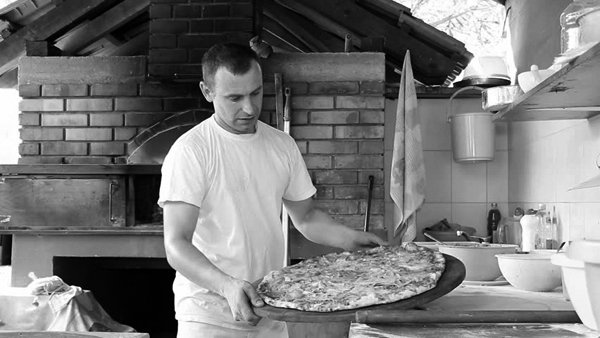

Welcome to Ghost Pizzeria, a proudly family-owned-and-operated restaurant with a generations-old legacy. We pride ourselves on carefully preparing traditional specialties: deliciously fragrant pizze distinguished by their golden colour, and a tenderness to touch and to taste.
Our restaurant lies on the Epping-Kilmore Road in a town called Wandong, which is an interesting name. As the story goes, when it came to naming his family’s selection at the foot of Mount Disappointment, Frederick Arkell, an ex-convict and ex-constable, nominated a haunting word that he had heard in distant Wiradjuri country. He had believed the word to mean ‘ghost’, and did not know that Wandong, a son of Baiame the sky god, was a bringer of affliction, a malevolent man-eater, and, that by imposing this name upon the district, he, Arkell, would curse it.
So, why establish a business with a high attrition rate risk in ill-starred Wandong? That’s a good question. See, our family has a connection to the region. For many generations, one branch of my family lived in a small town called Malfa, in Salina, an island in the Aeolian Archipelago. It was still a medieval agrarian society for decades after the unification of the Kingdom of Italy, and in the 1880s the Malfiati were still harvesting, winnowing and milling wheat in small batches by hand. When poor wheat harvests, grape phylloxera and raised taxes saw many members of his family turn to banditry, my great-great-grandfather Lorenzo Rodíquez left this island and moved to Naples, where he accepted a job with a wholesale fruiterer and married a cousin, Maria Concetta. In Naples, the couple had several children, but the third, Lorenzo Rodíquez’s namesake, our antihero for all intents and purposes, was born on the day that the Head of Table Services to the Royal Household summoned pizzaiolo Raffaele Esposito to prepare a selection of pizze for Queen Margherita. Her favourite, apparently, was one with red tomato, white cheese, and green basil: the colours of the tricolore.
Whilst Maria Concetta doted on Lorenzo Rodíquez Jnr, keeping the black-eyed boy at her side in the kitchen and instructing him in the preparation of foodstuffs, his truculent father derided him, seeing this replacement Lorenzo as a jettatore, a bringer of bad luck to whom he imputed his misfortune with employers, protection racketeers and mistresses, not to mention the then-ubiquitous shortage of grain. So in 1900, at eleven years old, when this overindulged jettatore was seen to be sufficiently self-aware, he was wrested from his mother and sent alone to ‘Melbuni’, where he would work as a fruiterer for his fathers’ relatives. At the time, due to chain migration, there were then more Malfiati in Melbourne than Malfa.
*****
Wandong is situated on Taungurung country, in the territory of the Nira-illum-balluk, which according to teachings from the Dreamings, have lived in the region since Balayang the bat pulled the first women out from the middle reaches of the Warring, the Goulburn River. Balayang took the women to his brother Bunjil the eaglehawk who had created the first men, and the women and men were commanded to live together. Bunjil apportioned responsibilities to the people, handing the men spears and instructing them to hunt kangaroos, then handing the women digging sticks and instructing them to harvest yams and roots. The roots that women harvested were often milled into flour and mixed with water to make dough, which was then baked in ground ovens. The bread made by these first bakers doubled as an edible plate that could be covered in toppings, a foodstuff that, in the Neapolitan dialect would have been generically referred to as pizza, was, in the Taungurung language, referred to as narronj.
Around the time that the Hume and Hovell expedition party were gawking at the Taungurung’s ground ovens, Andrew Beverdidge was attaching a steam engine to the masonry stove at his bakery in Dunfermline, Scotland, in an attempt to boost the production of his stodgy loaves. The Scot had a frenetic get-rich-quick mentality born of the desire to distinguish himself from his affluent family. He balked at the tartanry and nepotism of his ‘clan’, the Beveridges, who were officials that controlled the Dunfermline City Council.
An elopement and six children later, for self-help and free enterprise, this baker Beveridge set out on the Superb to transform the alleged wilderness of the Port Phillip colony into profitable pastoral land. He would, he predicted correctly, make his fortune driving merinos into the colony’s northwest, claiming land via freehold, and exporting fleeces to Scotland, the then textile capital of the world. His entire family, save his eldest son and namesake who was studying in Edinburgh, accompanied him to Australia.
Within months of arriving in the colony, the Beveridges drove two thousand sheep through the so-called Riverina up into Watiwati country, and ignoring the colonial government’s orders to leave the region, squatted on a vast territory where they established a homestead. Two years on, Andrew Beveridge Jnr petitioned the Edinburgh University Senate to grant him his degree early, without examination, in the interest of leaving Scotland, joining his family and occupying its territory claim in Taungurung country. Sympathetic to his ‘special circumstances’—for working fields in an exotic outpost easily substituted assessable fieldwork—the senate approved, and shortly thereafter, a bona fide Master of Arts became the manager of a cattle run known as ‘The Dene’.
Devastated by the massacres that countered their raids on squatters, the decimated and dispossessed Taungurung community upheld a truce for which European invaders were cautiously endured, and all the while, the Europeans’ actions were scrutinised and checked against Taungurung law. Such were the conditions surrounding Beveridge, Master of Arts, his younger brother Peter, and the several hundred bovines they drove on the Nira-illum-balluk’s territory. As the fertile ground which comprised ‘The Dene’ required very little of their attentions, the two inexperienced pastoralists (both would-be anthropologists) had occasion to indulge their fascination with indigeneity, ingratiate themselves with certain Taungurung people, and groom the young women for acts of carnal knowledge.
The Beveridges’ conduct did not go unnoticed, of course, but things only came to a head some years later. After the Beveridge family increased its territory claim northward and the brothers’ transgressions worsened, two Watiwati warriors informed the Beveridges that Andrew Beveridge MA, having been found guilty of sexual assault, was to be executed. Despite warnings having reached him, the warriors tracked and speared the perpetrator with little difficulty, and then took care to observe important cultural protocols—laying his body supine, smearing it with ceremonial ochre and covering it with a possum skin cloak—to aid the man’s soul in its journey.
The horrific period that followed this event was, as one of the Beveridges’ associates chillingly wrote, an “open season”. Many hundreds of Taungurung and Watiwati were indiscriminately killed—their bodies buried in mass graves—and a code of silence ensured that the genocide would not be brought to the attention of the colonial authorities. As for the two Watiwati warriors, they were dragged before Judge Charles La Trobe and charged with murdering a scholar over an argument about a sheep. Their testimonies were ignored as a matter of course, they were found guilty and summarily hanged.
Eventually a pointless conflict within the Beveridge family itself led to family members selling their interests and severing their connection to the Watiwati and Tuangurung countries. Shortly thereafter, a number of short-lived sawmilling operations sprang up on ‘The Dene’ cattle run, a selection newly christened Wandong. Thereafter a terracotta lumber mill operated in the area for a few years, a few other ventures started up and more or less immediately failed, and industry had ended in Wandong by the turn of the century.
*****
During the early twentieth century, Lorenzo Rodíquez Jnr worked in Melbourne as a fruiterer. After his fifteenth birthday, his father and older brother Antonio joined him in Melbourne, and the three worked together. Lorenzo Rodíquez Snr had grown increasingly antagonistic and drove his eldest son, the more sensitive Antonio, to hang himself from a rafter in the fruit shop. After this incident, in bad faith, Lorenzo Rodíquez Jnr defended his father in the Coroners Court, stressing that there had never been any quarrels at home.
Around the age of twenty, Lorenzo Rodíquez Jnr purchased his own business, started moving in 'Ndràngheta crime circles, and developed a costly gambling habit. During the Second World War, towards the end of his fruit peddling career, his nationality, crime world connections and public reputation for selling insufficiently creamy ice cream, made him the perfect example of a potential Fifth Columnist, someone sympathetic to the Axis powers. He was interned at Internment Camp No. 1, established out of sight and mind at the foothills of Mount Disappointment in Wandong, and there, languishing for the later war years, was charged with the ignoble responsibility of ridding the camp of vermin (wild dogs, wallabies, and wombats), of which he enjoyed the meat.
One day, after Lorenzo Rodíquez Jnr had completed a pest control rotation in the camp’s kitchen, the catering soldier, seeking to adapt the Ministry’s National Wheatmeal Loaf recipe to something conforming to the culinary tastes of the internees, permitted him to demonstrate the preparation and baking of a yeasted flatbread, which he topped with lard and wombat (so the story goes). The caterer was not impressed, but nonetheless, many years later as an elderly man, Lorenzo Rodíquez Jnr would recall this moment as a highlight of the war, and although it’s not much of a claim to fame, and it amounts to little when weighed on the scales of history, my great-grandfather did cook the first pizza in Wandong.
So take a look at our menu. We use the finest local and imported ingredients to prepare traditional finger-pressed pizza bases, topped with cheeses that come with a controlled and guaranteed designation of origin. As per product specifications registered under the European Union scheme concerning traditional specialties, our pizze are baked in a wood-fire oven at a temperature of four hundred and eighty-five degrees Celsius for no longer than seventy seconds. Our convenient online ordering system allows you to order without having to reach for your wallet or telephone.
Matthew Greaves, pizzaiolo